
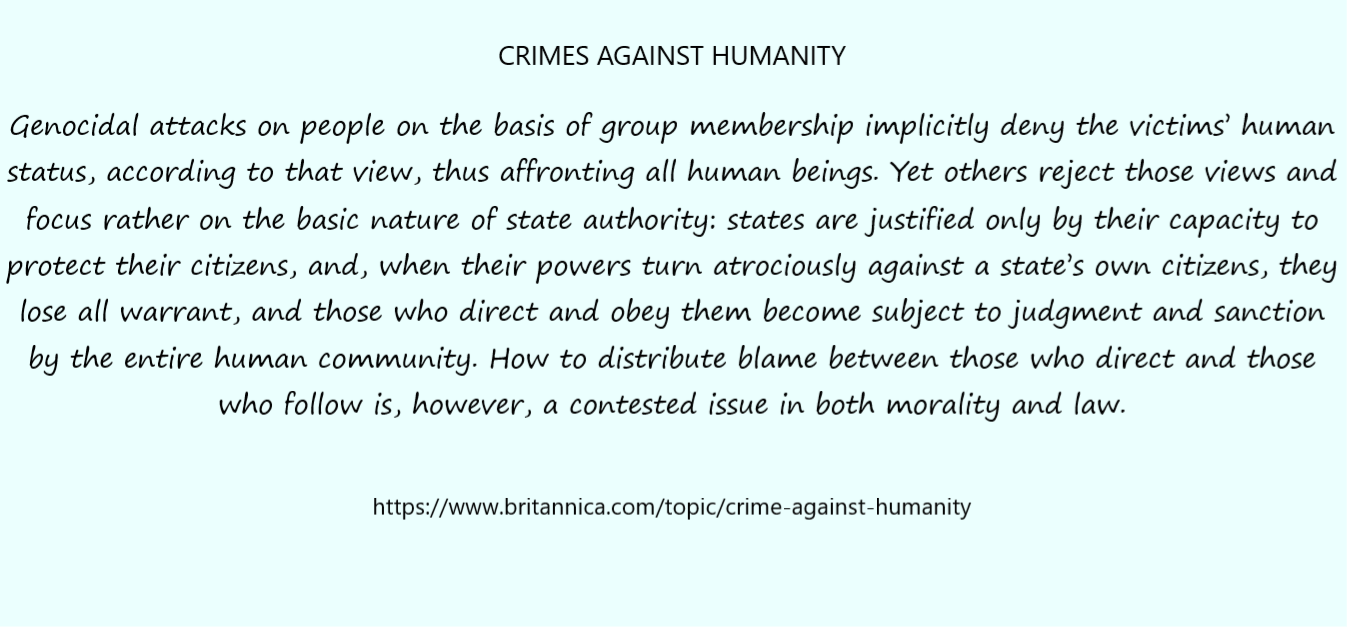
02/09/26 I can highly recommend reading the article below, by Dr Bruce Perry, who is an expert on child development and trauma. The six core strengths that children need to be humane… AKA to vaccinate against violence. If every parent/school followed his advice, we would not have so many social problems as we have today. I firmly believe they should start teaching this in primary schools, ( but they won’t! ) incorporating it into all areas of study and recreation time, throughout the years. There would be less violence and crime, and individuals would show more respect for each other.
[It is particularly important in these current times; as many parents who themselves were not taught or never acquired positive social skills; only pass on their own negative behaviour onto their children & others – who then also fail to socialise in a positive way. We learn behaviour from interactions with others, and from what we watch, read, learn etc; and if some children/adults are only exposed to hostility and anti-social behaviour; they will not know any better.
It is far easier to be friendlier to those you meet, than to make enemies of many. You never know when you may need someone to help you and there will be no one to turn to; if you always create hostile relationships & environments. E.g. accusing anyone [without any evidence to back it up] of being a *racist; actually strongly indicates the accusers of potentially being the real racist; when they project their own negative behaviours to blame shift – onto others. It actually creates more racial divisions in society (racism), by becoming a self-fulfilling prophecy: from introducing *race as a factor. https://www.britannica.com/topic/self-fulfilling-prophecy
“ self-fulfilling prophecy, process through which an originally false expectation leads to its own confirmation. In a self-fulfilling prophecy an individual’s expectations about another person or entity eventually result in the other person or entity acting in ways that confirm the expectations.”
*Race on its own does not matter, it is how kind and respectful those persons actually are; which matter the most and you can identify this by their actions and how they relate to others.
Please, Spread the word 🔽🔽🔽 and be part of a better world which enables decency and humanity to thrive and grow – for everyone’s safety and security. Bring out the best – not the worst in others. ]
https://teacher.scholastic.com/professional/bruceperry/cool.htm
KEEP THE COOL IN SCHOOL Promoting Non-Violent Behavior in Children by Dr Bruce Perry
“As you watch children cross the classroom threshold at the start of a new school year, you can’t help but wonder: Will they connect with me? Will they get along with one another? Today, as children enter the “world” of school, you must consider another factor-how can I ensure the safety of all the children in my group?
School shootings and the graphic violence we all see in the media change the way adults and children view the world-from a world bright and full of promise to a dark and potentially dangerous place. Even at the tender age of 2, children may experience a bully’s threat. A toddler may imitate his favorite cartoon character and suddenly tackle a friend on the playground. Exposure to violence can change the way children feel, act, and behave-and not in positive ways.
Children are born with a remarkable range of potential. They are not born violent, nor are they naturally immune to the effects of violence. Yet some children are more resistant than others and a rare few are unaffected. During these early years, you can increase children’s ability to be responsible, caring, and creative. You might say it’s the chance of a lifetime!
A Vaccine Against Violence
Bruce D. Perry, M.D., Ph.D, a leading expert on brain development and children in crisis, has identified six core strengths that children need to be humane. A child who can form and maintain healthy emotional relationships, self-regulate, join and contribute to a group, and be aware, tolerant, and respectful of himself and others will be more resourceful, more successful in social situations, and more resilient. Studies show that when a child is violent, one or more of these core strengths did not develop normally. The child without these strengths will be in greater danger of becoming violent and also less able to cope with bullies and other verbal or physical abuse. A child who does not develop these core strengths is a vulnerable child. Significantly, though, children with these core strengths rarely become violent and, in fact, recover more quickly when exposed to violence.
To help children develop these crucial strengths, Scholastic has launched KEEP THE COOL IN SCHOOL, a company-wide campaign against violence and verbal abuse. With this campaign, we hope to offer teachers, parents, and children the tools to identify, develop, and enhance these core strengths. Promoting a child’s emotional health is the most successful approach available to fighting violence. And the payback is unparalleled: With your help, more children will grow up to be kind, thoughtful, and productive.
The following article by Dr. Perry offers an explanation of these six strengths. Over the year, Early Childhood Today will present six additional features, each focusing on one of the core strengths.
The Six Core Strengths
by Bruce D. Perry, MD, Ph.D.
Violence infects our children. This infection is virulent in some and barely noticeable in others. Why do some children re-enact the violence they see on television while others do not? Why do some chronically teased children cope by developing a sense of humor, while others become self-loathing and yet others plot to shoot their taunting peers? Why do some children who make these murderous plans actually act on them?
It’s almost impossible to answer these questions. We rarely know what makes a given child violent. But we do know that children with core strengths rarely become violent. Healthy development is an antidote to the violence they’re exposed to.
These core strengths build upon each other to contribute to a child’s emotional development. Together, they provide a strong foundation for future health, happiness, and productivity. Attachment, self-regulation, affiliation, awareness, tolerance, and respect will each be explored in depth in later issues of Early Childhood Today. Here is an overview of the six core strengths and why each is essential to healthy development.
- ATTACHMENT: Being a Friend
Attachment is the capacity to form and maintain healthy emotional bonds with another person. It is first acquired in infancy, as a child interacts with loving, responsive, and attentive parents and caregivers.
Why it’s important: This core strength is the cornerstone of all the others. An infant’s interactions with a parent or primary caregiver create his or her first relationship. Healthy attachments allow a child to love, to become a good friend, and to have a positive and useful model for future relationships. As a child grows, other consistent and nurturing adults such as teachers, family friends, and relatives will shape his ability to develop attachments. The attached child will be a better friend, student, and classmate-which promotes all forms of learning.
Signs of struggle: A child who has difficulty with this strength has a hard time making friends and trusting adults. She may show little empathy for others and act in what seems to be a remorseless way. Children unable to attach lack the emotional anchors needed to buffer the violence they see. They may isolate themselves, act out, reject a peer’s friendly overtures, or withdraw socially. With few friends, and apparently disconnected from her peers, this child is also at greater risk when exposed to violence.
- SELF-REGULATION: Thinking Before You Act
Developing and maintaining the ability to notice and control primary urges such as hunger and sleep-as well as feelings of frustration, anger, and fear-is a lifelong process. Its roots begin with the external regulation provided by parents or significant caregivers, and its healthy growth depends on a child’s experience and the maturation of the brain.
Why it’s important: Pausing a moment between an impulse and an action is a life tool. Developing this strength helps a child physiologically and emotionally. But it’s a strength that must be learned-we are not born with it. As children grow, our expectations for them must be age appropriate. For instance, it’s unreasonable to expect a 2-year-old to have complete bladder and bowel control before his body has matured. In social situations, the age-appropriate strength to self-regulate may spell a child’s success and build his self-confidence.
Signs of struggle: When a child doesn’t develop the capacity to self-regulate, he will have problems sustaining friendships, learning, and controlling his behavior. He may blurt out a thoughtless and hurtful remark and express hurt or anger with a shove or by damaging another child’s work. Just seeing a violent act may set him off or deeply upset him. Children who struggle with self-regulation are more reactive, immature, and impressionable, and more easily overwhelmed by threats and violence.
- AFFILLIATION: Joining In
The capacity to join others and contribute to a group springs from our ability to form attachments. Affiliation is the glue for healthy human functioning: It allows us to form and maintain relationships with others-and to create something stronger, more adaptive, and more creative than the individual.
Why it’s important: Human beings are social creatures. We are biologically designed to live, play, grow, and work in groups. A family is a child’s first and most important group, glued together by the strong emotional bonds of attachment. But most other groups that children join-such as a preschool class, kids in the neighborhood, friends made while traveling-are based on circumstance or common interests. It’s in these groups that children will have thousands of brief emotional, social, and cognitive experiences that can help shape their development. And it is in these situations that children make stronger connections with peers-their first friendships.
Signs of struggle: A child who is afraid or otherwise unable to affiliate may suffer a self-fulfilling prophecy: She is more likely to be excluded and may feel socially isolated. Healthy development of the core strengths of attachment and self-regulation make affiliation much easier. But a distant, disengaged or impulsive child won’t be easily welcomed into a group. And in fact, she may act in ways that lead others to tease or actively avoid her. The excluded child can take this pain and turn it on herself, becoming sad or self-loathing. Or she can direct the pain outward, becoming aggressive and even violent. Later in life, without intervention, these children are more likely to seek out other marginalized children and affiliate with them. Unfortunately, the glue that holds these groups together can be beliefs and values that are self-destructive or hateful to those who have excluded them.
- AWARENESS: Thinking of Others
Awareness is the ability to recognize the needs, interests, strengths, and values of others. Infants begin life self-absorbed and slowly develop awareness-the ability to see beyond themselves and to sense and categorize the other people in their world. At first this process is simplistic: “I am a boy and she is a girl. Her skin is brown and mine is white.” As children grow, their awareness of differences and similarities becomes more complex.
Why it’s important: The ability to be attuned, to read and respond to the needs of theirs, is an essential element of human communication. An aware child learns about the needs and complexities of others by watching, listening, and forming relationships with a variety of children. He becomes part of a group (which the core strength of affiliation allows him to do) and sees ways in which we are all alike and different. With experience, a child can learn to reject labels used to categorize people, such as skin color or the language they speak. The aware child will also be much less likely to exclude others from a group, to tease, and to act in a violent way.
Signs of struggle: A child who lacks the ability to be aware of others’ needs and values is at risk for developing prejudicial attitudes. Having formed ideas about others without knowing them, she may continue to make categorical, destructive, and stereotypical, judgments: “She speaks English with an accent, so she must be stupid” or “He’s fat, so he must be lazy.” This immature kind of thinking feeds the hateful beliefs underlying many forms of verbal and physical violence.
- TOLERANCE: Accepting Differences
Tolerance is the capacity to understand and accept how others are different from you. This core strength builds upon another-awareness (once aware, what do you do with the differences you observe?).
Why it’s important: It’s natural and human to be afraid of what’s new and different. To become tolerant, a child must first face the fear of differences. This can be a challenge because children tend to affiliate based on similarities-in age, interests, families, or cultures. But they also learn to reach out and be more sensitive to others by watching how the adults in their lives relate to one another. With positive modeling, you can insure and build on children’s tolerance. The tolerant child is more flexible and adaptive in many ways. Most important, when a child learns to accept difference in others, he becomes able to value the things that make each of us special and unique.
Signs of struggle: An intolerant child is likelier to lash out at others, tease, bully, and, if capable, will act out his intolerance in violent ways. Children who struggle with this strength help create an atmosphere of exclusion and intimidation for those people and groups they fear. This atmosphere promotes and facilitates violence.
- RESPECT: Respecting yourself and others
Appreciating your own self-worth and the value of others grows from the foundation of the preceding five strengths. An aware, tolerant child with good affiliation, attachment, and self-regulation strengths gains respect naturally. The development of respect is a lifelong process, yet its roots are in early childhood, as children learn these core strengths and integrate them into their behaviors and their worldview.
Why it’s important: Children will belong to many groups, meet many kinds of people, and will need to be able to listen, negotiate, compromise, and cooperate. Having respect enables a child to accept others and to see the value in diversity. He can see that every group needs many styles and many strengths to succeed and he can value each person in the group for her talents. When children respect-and even celebrate-diversity, they find the world to be a more interesting, complex, and safer place. Just as understanding replaces ignorance, respect replaces fear.
Signs of struggle: A child who can’t respect others is incapable of self-respect. She will be quick to find fault with others, but she can also be her own harshest critic. Too often the trait a child ridicules in others reflects something she hates in herself. The core of all violence is a lack of respect, for oneself and for others. When respect is missing, children will likely become violent-because they value nothing.
These core strengths provide a child with the framework for a life rich in family, friends, and personal growth. Our world changes daily and becomes increasingly diverse-and how much more complex that world will be when our children become parents! Teaching children these core strengths gives them a gift they will use throughout their lifetimes. They will learn to live and prosper together with people of all kinds-each bringing different strengths to create a greater whole.”
This article originally appeared in Early Childhood Today magazine.
SIDEBAR: Dr. Bruce D. Perry, M.D., Ph.D., is an internationally recognized authority on brain development and children in crisis. Dr. Perry leads the ChildTrauma Academy, a pioneering center providing service, research and training in the area of child maltreatment (www.ChildTrauma.org). In addition he is the Medical Director for Provincial Programs in Children’s Mental Health for Alberta, Canada. Dr. Perry served as consultant on many high-profile incidents involving traumatized children, including the Columbine High School shootings in Littleton, Colorado; the Oklahoma City Bombing; and the Branch Davidian siege. His clinical research and practice focuses on traumatized children-examining the long-term effects of trauma in children, adolescents and adults. Dr. Perry’s work has been instrumental in describing how traumatic events in childhood change the biology of the brain. The author of more than 200 journal articles, book chapters, and scientific proceedings and is the recipient of a variety of professional awards.”
Dr Bruce Perry – Early Brain Development: Reducing the Effects of Trauma
“The Great Rewiring of Childhood, in which the phone-based childhood replaced the play-based childhood, is the major cause of the international epidemic of adolescent mental illness.” another first-class video and transcript guided by rational thought and evidence from the ACADEMY OF IDEAS.❤❤❤
Too much time spent using the internet – results in a wasted existence and is denying everyone the opportunity to a more sociable, productive, healthier & a life. Your children’s mental/physical health and social development are dependent on parents/grandparents/caregivers weaning the children [and themselves] from the internet devices and substitute with real-life fun and play. You could start by organising activities with them, and then let them choose for themselves using their own imaginations to encourage creativity skills. However, during the week, you could ask older siblings to research & make a list of activities they think others might like to try. Not only will you have a closer bond, but by creating happy memories together, you will help the children develop coping and social skills to prepare them for adulthood.
Due to the noticeable decline in security on our streets, safety must be addressed at all times. Obviously, younger children should never be left unsupervised. Remember, having fun together can improve the mental health of adults too. Make sure your home is secure before leaving it in case it is being watched, as crime gangs observe daily habits, in areas they want to rob.
I have already suggested some practical advice in the section: PUT SOME FUN AND PURPOSE BACK INTO YOUR LIVES
CHOOSE, a healthier and more secure alternative…
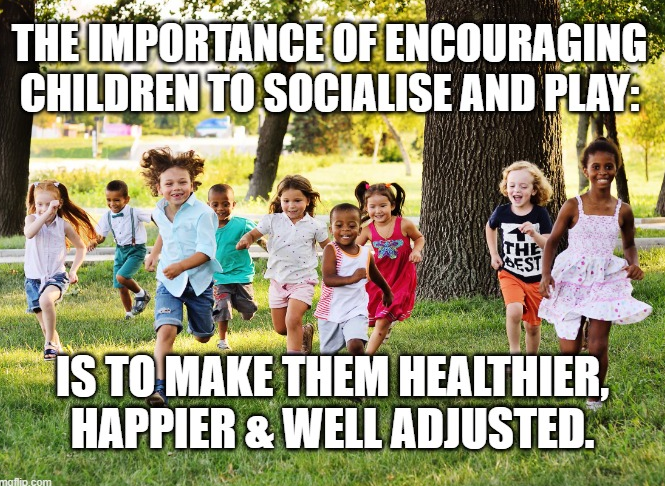
Families should organise a fun day inside or outside with their kids, every week where possible. You will all have something to look forward to. Adults can shove an invitation, though the doors of families you can trust. Look for a grassed area of open space which can be used. Your kids will be safe with several responsible, trustworthy adults watching over them. You will also learn more about who lives near by and as you get to know each other better, you can share useful advice, assistance etc and perhaps discuss a Neighbourhood Watch Scheme with home CCTV, to monitor any suspicious behaviour in the area.
Ask them if they have any useful items which the children can share – to play with, but stop the kids using phones. They are addictive, which is not good especially when they are also being used to ‘brain wash’ the kids. Peer pressure online; has increased incidences of bullying and abuse.
You could organise ball games, running about for exercise to help you all sleep better. Aim to increase positive social interactions between the kids. Make a set of ‘friendly rules’, whilst discouraging negative behaviour e.g. bullying. Please use every opportunity to teach social & moral values to bring about positive change.
When I was at school we had sports days with egg & spoon races, sack races and parents had to compete against each other too. Kids love watching adults having fun and laughing together. Try to avoid spending too much money for equipment, be resourceful and improvise etc. Or, ask local council for loans of equipment for the day (you will find out what kind of people they are !) They say that ‘misery loves company’ well prove to them that promoting happiness is much easier and less problematic to deal with. Be happy and enjoy yourselves, despite the misery makers all around.
You could even organise communal social occasions; barbecues, Xmas parties, and save up for a day out during the school holiday time etc. As a result of putting this effort in, you will reap the benefits. You will sleep better, have fun, be healthier; mentally and physically and be closer as a family and as members of your community, I bet more will want to join your group, when they see how happier you are away from everyday stresses.
For those who have either forgotten or who have never experienced a safe, secure and happy life, I will relay my own childhood experiences to you, in the hope you will motivate, & stand together to choose life and not servitude. Our back is against the wall, we MUST join together to come out fighting for our safety and security.
‘I grew up in a quiet street in a clean area full of people who were kind and respectful, very sociable, and made every effort to live peacefully beside their neighbours. Residents & shopkeepers kept their entrances clean.The local shops were run/often owned by local people and customer service was amazing. You did not have to buy in bulk, you could buy as little as 2 ounces of cheese, butter etc ( about 56.7 grams) and most people cooked their own healthier meals, which were not laden with harmful additives. Family life was encouraged, as both parents were not forced into work to make an adequate income. Morals and values/ & good housekeeping skills were taught at home and at school.
Incomes were obviously much lower, but you got a lot more for your money than today and you were not taxed/fined to death. You could afford a weekly social life, holidays and home buying was much more achievable. Front doors were not usually locked during the day ( it was less dangerous back then), and children played traditional games, with balls, skipping ropes, and with their toys, bikes, & prams on much safer streets. There were Saturday morning cinemas – which many kids enjoyed and parents were happy as it was affordable, and sometimes the venue held competitions with good prizes at no extra cost. Bigger companies put money back into the community, for example: The Brooke Bond Tea company asked you for an empty packet of tea ( it had a collectible stamp on the front – for your admission ‘charge’ instead of money), taken to the local bingo hall, [who allowed it to be used for these annual events]; hosting a kind of party for the kids, with cartoons, films and free raffle prizes.
Compare with how safe, healthy and happy the kids are today.
Everybody (above a certain income), paid 20p for prescriptions and the NHS was safer, more reliable and trustworthy. The police walked the streets, investigated all crimes including burglary, theft, assaults etc. They protected the public who paid their wages, and in return they received the publics trust and respect. All of this has gone.
Pupils were not heavily indoctrinated by dysfunctional authorities with twisted, evil agendas. Neither did schools teach an adult rated sexual education, as the teachers would have been arrested and charged under indecency laws. The education authority would never have got away with it.
P.E. classes were twice per week, including swimming, netball football, rounders, cross-country runs, discus, high jump, or gymnastics etc. I was naughty, I dodged out of netball because it caused me throat problems, and amazingly, I still had good comments on my school report, even though the P.E. teacher had never set eyes on me. I think she did it because after a year – she suddenly realised I was absent and it made her look bad!) Cookery/ needlework or joinery one afternoon per week. Children learnt about different cultures from outings to the theatre and with fun activities in class. School outings were a regular part of education and pleasure, e.g. to see puppet shows, or a trip to the theatre, visit famous places like Hadrian’s Wall, Whitby Abbey etc & we visited local newspaper offices and more to encourage employment or training choices.
Kids played together near their homes and older ones looked out for the younger ones, because all the parents and kids knew each other very well and fully supported each other. For decades the govts have destroyed family life, communities/ and any resemblance of a social life by creating divisions in society, promoting hostility, increasing social problems [& ignoring them], resulting in maximum mayhem and chaos; depriving us all of reliable support. They have pushed everyone further into poverty. They want everyone dependent on the members of the WEF/WHO/UN etc – who are only interested in fulfilling their own evil agendas – which they want to FORCE upon you.
❤❤❤❤❤❤ Fun, laughter, exercise, community spirit…
Grandparents can offer so much to the community; sharing skills and knowledge including table tennis, art & crafts, knitting/crochet/macrame, hand/machine sewing, baking/cooking, gardening, woodworking skills, calligraphy etc. Discuss and implement some of the traditional games they played on the streets or in open spaces; eg. chuck stones, hopscotch, skipping, rounders. This may open up ideas for their future hobbies and careers.
When I grew up I never came across a depressed child, unless they came from abusive environments. ADHD, AUTISM and many other health issues did not exist. Families ate healthier food they prepared themselves, and taught their kids how to cook & keep house. They also taught children critical thinking, and other social skills through direct and indirect teachings, to enable them to interact well with their neighbours & become socially acceptable members of society. The lack of animosity inside communities avoided many disputes and was mutually beneficial; as people actually looked after each other.
Corporate greed and incompatible leaders have ruined millions of lives, it is time for the public to make the effort to bring about positive change – by taking on the responsibility ourselves – to improve family and community life to the benefit of all concerned.


[…] THE IMPORTANCE OF ENCOURAGING CHILDREN TO SOCIALISE AND PLAY. […]